When we started developing the website, we read the posts of Rosane regarding Environment & Manking in our orkut community. She reflects the things so nicely that it is understood very easily by all. So, an idea came to our mind to present her knowledge and innovation through blogs by attaching it to our website. In this way, we can help lots of people (that is the mission of our group).

When we sent her a mail discussing this idea, we got a reply in a day. You yourself read her views on writing the blog:

"The peace I have today is different from the peace I’ve dreamed one day.
Only with time, have I learned that peace is to take responsibilities and fulfill them; is to have serenity in the most difficult moments of life.
Today I want to hear and speak words that build. I want to have the courage to cry or to smile whenever I feel like doing it...
I want to accept with humbleness that I don’t know everything, but I want to share the little I know.
I like to remember that nature is so exuberant exactly because the differences it shows in its creatures. Each one of us is special, on Earth, and we have the mission that the Divine Creator has entrusted us.
I want to bring: peace, joy and much news."

Showing posts with label Environment. Show all posts

Friday, March 18, 2011

Effects of radiation on the environment.

Japan was hit on Friday (11) by a earthquake of magnitude 9. The quake affected the electricity supply, which caused a breakdown in the cooling of the reactors in a atomic plant. According to the International Atomic Energy Agency (IAEA), the risk of core melts, the worst accident that can occur in a plant is "great." The radiation in cases of major spills can contaminate water, soil, animals and everything that has life.
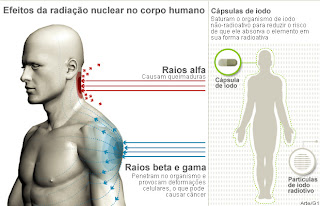
If melting occurs, three types of radiation are released into the environment:
Alpha, beta and gamma:


.
Alpha radiation can not penetrate the body; it causes a skin burn; the beta and gamma radiation - mainly gamma - enter the body and cause cellular deformation.
This is the same gamma radiation used in radiotherapy treatments, just to fight cancer. At low doses, it destroys tumors. At high, it can cause cell damage that leads to cancer.
The radioactivity can affect health in two main ways: When is ionizing, means: It is capable of changing the chemical structure of substances. With this, it changes the characteristics of common substances in our body; from the water, for example, it can form free radicals, which, in excess impairs the body's functioning.
Another possibility is that nuclear radiation directly affects the cells. The change in chemical structure of the elements can represent, for example, breaking of the DNA chain.
The modern medicine, still, can not tell if there is a limit amount of radiation to which the body must be exposed to such effects could develop cancer.

Exposure to rays is not the only risk to which the human body is subjected in relation to radioactivity. It is even more important to prevent people incorporate radioactive material. The most common way this happens is by inhalation of gases that mingle with the atmosphere after a leak.
One element that represents a bigger threat in this sense is iodine. The human body needs it to function normally and the thyroid tends to absorb radioactive iodine particles that are suspended in the air. To prevent this, are being given pills non-radioactive iodine to the population. Thus, the body becomes saturated and the element, even if it is inhaled in radioactive form, will not be absorbed.
The meltdown of a nuclear reactor does not kill people like a bomb. What kills even in case of a nuclear bomb is not the radiation, is the shock wave, then the heat wave and finally the radiation. Intensity of radioactive material in a nuclear bomb is much greater because the energy spent is very large and has no barrier. Yet, a reactor has four barriers against the release of nuclear material into the environment.

Wednesday, January 19, 2011

the magic of trees!

The mere presence of them awakens a peace and quiet in the human soul. This is a secret that explains why - from the earliest times - in all corners of the world, the sages and mystics have used forests as places of refuge and inspiration. There is a natural and instinctive bond between trees and mankind. Even their breathing modes are complementary.


It's hard to imagine beings as beneficial as the trees. They beautify the landscape, providing shade, timber, fruit, and are the refuge and shelter for birds and other wildlife. Communicate underground with the atmosphere and purify the air. Attract clouds, regulate rain, stabilize the climate and ensure the soil moisture. Combat erosion and prevent excess of wind.
Every human being, as each tree is a miniature and a summary of the universe.
The English poet Alexander Pope wrote that a tree is "something nobler than a prince in his coronation costume".

Trees have a strong magical nature. They are universally regarded as a symbol of the relationship between heaven and earth. With its vertical structure - the trunk - the tree establishes a symbolic axis linking the physical world and the divine world. Moreover, its branches, twigs, leaves and fruits gather a whole community of birds, insects, reptiles and small mammals, which is a symbol of the infinite diversity of life.
Imagine the universe as an inverted tree that has its roots in heaven and their leaves and fruit on earth.
This tree represents mythological every human soul, and whose origins are rooted in eternity, but whose leaves and fruits are the practical activities of the concrete world.
Every human being, as each tree is a miniature and a summary of the universe. This is one of the reasons we have much to gain by living with the trees. The experience of communion with them is part of a larger communion with all nature and the human soul freed from their suffering.
There is nothing better to relieve the suffering of the soul than walking through the forest, feeling its energy to revitalize the spirit. Be baptized in the waters of a stream.
But mankind forgot to supply their forces in nature and go for searching consol in rampant consumerism that destroys forests.
In the ancient world, new civilizations appeared healthy in forested regions as well. Some time later, populations have multiplied and wood consumption grew excessively. The trees were used as firewood - something essential to melt metal - and also as material for building houses and boats.
Our poor human intelligence can only win when we realize the intelligence of the trees. The content of the lessons they bring to us, however, depends on our ability to put aside the little things that we think we know, and open ourselves to the magic of life ...
To the magic of trees!


Thursday, January 6, 2011

2011 is the International Year of Forests.

Throughout the bowels of the forest, happily flying are the butterflies and the moths; as pure as children, they welcome the happy faces of the daisies that for being so white dazzle the eyes; In the distance can be seen the yellow, purple and white Ipe-tree; multicolored natural arrangements that blend with the softness of the clouds hanging over their top.

The pervasive silence of giant conifers sprout from the incessant singing of the cicadas in their farewell to the brief life they have on surface.Years spent beneath the earth bring them above so as to sing their songs until face their fate; pure symphony. They join the birds in chorus toasting to freedom. They celebrate the harmony of colors and the funny  of dead branches where they make their nests and lay their eggs spreading life.

On the ground can be seen the mushrooms, ears of the forest, home of the toads. In the cri-cri-cri of the crickets mixed to the croaking are the crackling dry leaves fallen on the soil, where death is just a detail in the proliferation of life that turns rot into a perfect meal for the soil; This soil which holds hundreds of tiny beings invisible to the naked eyes, that ashamed hide behind big sunglasses.

From it, the sun, comes so much wealth. Without it there would be nothing but darkness, with it everything lights up, grows and gains colors; those colors play with our imagination; tones mingle making all things new. Green, red, yellow, blue and white when mixed create a magical kaleidoscope through the brush.

Mountain down, fearless clear waters wash the shores of the streams; transposing the obstacles boldly, without being beaten. Bowing down before the big rocks in respect, knowing of its hardness, its power to stall the flow, but bravely waters pierce the barriers cornering unimaginable in order to achieve its ultimate goal: The sea.

And above all, endlessly blue, the sky remains; as if watching this whole miracle of the lush forests.

2011 is the International Year of Forests.
Forests cover 31% of all Earth's land area and have direct responsibility in ensuring the survival of 1.6 billion people and 80% of terrestrial biodiversity. For their importance to the planet, they deserve to be preserved and valued more; therefore, the UN declared that 2011 will be the International Year of Forests. Do your part, care!

Saturday, December 18, 2010

Sustainable development

photo credits Rodrigo C. de Souza


When we talk, our words are often best understood not only by the meaning itself, but also by the tone of voice we use. I believe, it occurs the same thing to the written words, depending on who writes.

It reminds me a couple just married gazing the horizon. The bride commented:” Oh, those clouds covered the moon!” And then the groom replied: “No, it was ashamed of your beauty and hid itself!”

Thirty years later, the same couple, beneath the same moon…Hey, dear look, the moon has hidden itself…

“Don’t be stupid! Can’t you see it is going to rain!!?”

Thus the term "sustainability" when written by someone of the capitalist system means you can dispose of land and resources to continue shameless to serve the consumer market, to the profit without measures and to the technological development for palliative solutions.
In order to maintain this cycle, they should avoid by all means, that new emerging countries rapidly deplete the assets of the land and threaten the level of consumption of the richest nations.
Imagine if Africa with its millions of people entering the wave of consumerism. The cake of global wealth will have to be shared into smaller slices to serve everybody. Sustainability in this sense means restricting new consumer markets in order that the feast of the rich countries is extended.


On the other hand over the viewpoint of a writer from a developing country, sustainability takes on a tone to share with more justice, restraining wasting in rich countries, especially with the surplus, avoiding excessive consumption, restraining the arms industry and using oil for individual transport.
Those can only accept a development that is present for all humanity and ensure the future of new generations; because the leftovers from the tables of the rich people are in lack on the tables from the poor ones.

Maybe the groom should have known better and if instead of the first answer just have replied: “Let’s get inside” He could still use the same answer thirty years later without any problems.

Will we be able to enjoy our natural resources in thirty years, being kind in our answer to the situation we’ve been facing in our planet today?

Remember that nothing lasts forever and we should face the reality without romantics’ feelings that lead us to disappointments in the future.

Saturday, December 11, 2010

Cop-16

Another year comes to an end and next week I am on vacation ...Here in southern hemisphere we will enter summer time. Lots of sun, beaches some heat, by the way, “hell’s heat". Last year we reached 50 ° C here in Rio de Janeiro. But Brazil is so good ...In the morning the blue sky gives us a sense that paradise is just around the corner, around noon white clouds cover the entire scenario and a fresh wind blowing through the trees. At three o'clock the white clouds become black and that goes down storm with thunder and lightning. At 8 pm ... Moon and many stars. Let me enjoy while we still have beaches once due to the increasing level of water on the oceans our beaches are disappearing… check this post:


Travelling would be great. Spending my vacation in Cancun who knows? 
Speaking of Cancun, it ended yesterday the meeting of world leaders to discuss the reduction of carbon emissions and all that stuffs. What they were trying to settle was a mechanism that would ensure transparency by major emerging countries. These countries in turn said they would only accept such measures, were adopted another type of transparency - Financial - from the part of industrialized countries.
The deal is this: Nobody wants to give up economic growth because of global warming. Let the glaciers melt or the oceans to warm up.

Ivo Morales, Bolivia's president, warned that if they send the Kyoto Protocol to the rubbish bin they will be responsible for genocide and ecocide because they will be sending many people to their deaths.

Mexico has proposed they include the establishment of a new "Green Fund for Climate" to help the world's least developed countries, payments for the protection of tropical forests and another agreement to share technologies with low carbon emissions.

Jairam Ramesh India’s Minister of environment says there should be an initiative to stipulate that all countries whose emissions account for more than 1% or 0.5%, of total global emissions, submit a report every two years. The frequency would be lower for others.


Apparently, Transparency will come only from the water that runs down the mountain due to the warmth up there, because not even our river water is so transparent anymore due to pollution. But this is subject for another post.

See you there!

Sunday, December 5, 2010

Is it worth it palliative solutions for global warming?


Global warming is here knocking on our door. It seems to be here to stay. And what scares me most in this story are the attitudes of some scientists and others who no longer talk of avoiding it or do it backwards, but try to adjust our lives to what is understood as inevitable.
What leaded me to this conclusion was some news I read in Internet and will transcribe part of it for you here:

"The Agriculture Ministry of Japan announced that they will develop a new type of rice resistant to heat and lack of water, in anticipation of shortages caused by global warming. The measure is part of a study that foresee decreases in rice production and loss of forests if the levels of carbon dioxide in the atmosphere duplicate and increase the level of mercury. "
The news showed also the increasing average in the level of carbon dioxide in the atmosphere by the end of the century, but to me, a laywoman like most who read it, caused a deep malaise. I could not applaud the efforts of scientists to try pulling rabbits out of the hat in order to the human species continues to survive despite the damage it causes to the planet. Are we right in our final days or will we adapt and survive? Despite all the intelligence, will we perish like the dinosaurs?
These are issues that alarm us all today and much more will alarm our grandchildren in 30 or 40 years if instead of action to stop this insanity that is the pollution and devastation of our planet, we prefer palliative to live with it.
I fear that they perform the feat of not only develop a rice more resistant to heat, but also taking advantage of the excessive heat of global warming, and get this cereal produced already cooked.

While leaving my worries to overtake me and wandered into daydreams, my daughter - who was sleeping on the couch - woke up and came to me in search of caring. She is 8 years old and is one of those who will inherit this beautiful planet and the changes carried out by us that are slowly changing the Earth’s face. She came, rubbing her eyes with the back of the hand, yet drowsy and yawned long while nestled in my lap. She looked at me and smiled gratefully by the reception and care received . But she said something that made me gloomy and thoughtful, "Mom, I dreamed that in 2100 the chickens will lay fried eggs.”
I frowned, said nothing to her, but here to myself I thought: "It makes sense”!

Tuesday, November 30, 2010

UN Climate Conference in Cancún


The UN conference on climate change, inaugurated on Monday in Cancun (eastern Mexico), opened 12 days of discussing and intends to restore credibility to a process of international negotiations weakened by the failure in Copenhagen last year.

Army troops and police in Mexico, supported by three warships, part of the security arrangements around the hotel Moon Palace, a complex on the seafront, where is the conference to be held for the next 12 days.

The word Cancún means "golden snake", but there is no poison in this Yucatan paradise kissed by the sun. Mexico's most famous destination, Cancun delights with its incredible beaches with crystal waters and white sand: You can ride along the coast, diving free canoe in a reserve and swim with dauphins. Along with various bars and restaurants can be found.


But more than a walk on the beach, there are advances that must occur from now on in Mexico. Opened the meeting which follows the failure of COP-1, environmentalists charge seriousness in the work; despite being almost impossible to establish a legal and valid agreement in Cancun to limit temperature increasing to 2 ° C - considered by scientists as a relatively safe level.
U.S. and China are the two largest emitters of greenhouse gases, and charge each other more effective measures to reduce their emissions. A new failure in this year's conference will launch serious doubts about the future of the Kyoto Protocol, which stresses the importance of the market for carbon emissions as a form of control.


One possibility for global climate policy would be to extend the Kyoto Protocol, which requires reductions in emissions of greenhouse gases by developed countries.
The U.S., the largest emitter among developed countries do not participate in this treaty. The signatories say they would accept further reduce their emissions by 2020, replacing the use of fossil fuels by renewable energies, since the U.S. and large emerging economies like India and China, also assume the obligation to make reductions.
The big developing countries, however, argue that reducing emissions - and therefore power consumption - would undermine its efforts to combat poverty. They argue that rich nations have benefited from more pollutant emission, and therefore should bear the burden of fighting climate change.


Sunday, November 28, 2010

Are we able to preserve the planet we live on?


Upon discovering a small island in the South Pacific, on Easter Sunday 1722, Dutch navigator Jacob Roggeveen felt impressed. Not by the beauty, because he had seen much more idyllic islands. What raised eyebrows were giant stone statues scattered around the island. 3600 km distant from the nearest continent, South America, and 2,000 km from the nearest island, Pitcairn, Easter Island is one of the most isolated spots on the planet. In the 150 years that followed, at least 53 more European expeditions reached the piece of land. The logbooks of explorers reported that, on each visit, unless those enormous figures were spotted in the distance: they were all being cut down. Until in 1825, the crew of an English ship did not find any more standing.
According to European explorers, the statues, called moai, seemed to witness a society in collapse. Roggeveen himself wrote in his diary: "The destroyed look could not give another impression beyond poverty and unproductive individuals." In the mid-18th century, the Rapanui people, who inhabited Easter Island, was already in decline.
Well before the arrival of Europeans, the island had experienced centuries of progress, with booming plantations and abundant food. At some point, however, something went very wrong. The population has grown too, the forests are gone, the soil was eroded, agriculture did not prosper more rapanui and villages went up in wars. For a large number of researchers, the collapse was caused by the careless actions of man over nature. No wonder that Easter Island is currently indicated as a kind of metaphor of Earth's future: what happened to the Rapanui is more or less what can happen to us.

The stone statues were built in honor of someone important to the clan who had died. Its strategic location - backs to the sea, looking for the village - that was for, right from the afterlife, the deceased continued to look for his people.


Between ages 11 and 14, the company Rapanui lived his glory days. The volcanic soil favored the cultivation of various foods. The efficient agriculture resulted in a growing population - estimated that the island once had 15 thousand people. Then the problems started. A greater number of people demanded that more areas were devastates. Planting on a large scale requires an open field, were other demands for wood for use as fuel and the structures of houses and boats.
The palm trees were used to build canoes that the islanders used at sea to fish an important item of their diet: dolphins. As the marine life around the island was not as abundant, only the most experienced fishermen, with their double canoes, could bring dolphins to the table. The meat of the animal was greatly appreciated, as well as seal and 25 types of wild birds. Guess how it was all cooked? With the burning of wood removed in the forests.
But not only was the food that caused deforestation. It was intensified by a dispute that has engulfed the island: The obsession with building moai. The different villages were creating ever bigger statues. The first moai, which would have been made around 1100, were between 2 and 3 meters tall. The highest put on an altar, carved some 300 years later, is 10 meters and weighs 82 tons. At the foot of the volcano Rano Raraku, where all the moai were built, there is a statue with more than 15 meters and about 270 tons, which was never completed.
But what do moai has to do with cutting down trees? The researchers, lead a moai from the volcano to a village and leave it standing up was a job that required lots of wood In addition, one quarter of the food of Rapa Nui was consumed in the production and transportation of the moai - activities that involved between 50 and 500 people each time.
As the palm trees were uprooted, a number of problems on the ground began to appear. "The farmland was exposed to sun, wind and rain. The soil was eroded and many villages were uninhabitable because nothing flowed around them. With the destruction of fertile soil, it is not difficult to imagine dramatic famines in Rapa Nui.
In a period of warfare between villages, when defeated members of a particular clan, the winners toppled the moai face down to the ground - the ultimate humiliation that could be made. The European expeditions that visited Easter Island helped to worsen the crisis, spreading epidemics and taking people as slaves.

The Rapanui people no longer exists because it was not able to preserve the island where they lived. Their legacy serves as a grim warning.


Are we able to preserve the planet we live on?

Thursday, November 25, 2010

Scientists will drill the Dead Sea in order to study Climate Change.

DOSECC view of drilling on the Dead Sea, photographed on November 17, 2010. At the time of the photo equipment was ready to be towed to the location of the perforations, approximately 6 km to the northeast. 


About 40 researchers among Israelis, Palestinians and Jordanians began the task of drilling the Dead Sea in search of the sediment and sludge that will reveal histories until 500,000 years ago. The samples will help to understand issues from the ancient Middle East geology, archeology to climate change on Earth.
The project that took a year to be approved by Germany will cost 2.5 million dollars and will last 40 days. The drill used in scientific research the world has the capacity to reach up to 1,500 meters deep.

The Dead Sea, actually a large lake of 402 square kilometers, is located in a valley surrounded by the West Bank, Jordan and Israel. Only do the river Jordan flows there, which causes the accumulation of sediment in the deep interior virtually intact over millions of years.
Read more about the Dead Sea and Jordan River on my post:  

 http://panchtatva-blog.blogspot.com/2010/10/sea-of-galilee-or-lake-of-galilee-is.html
The sludge withdrawn from 
 the Dead Sea will reveal through its layers of light and dark, ancient and recent periods of rainfall, droughts and floods and therefore the dominant climate on Earth and the effects of global warming .In the bed of the Dead Sea two layers of sediment accumulates each year.
Another interesting finding is the evidence of earthquakes where the sediment layers are not aligned.
For anthropology the study will help in the theories about the migration of primitive man, which many researchers believe have passed through the area of the Dead Sea basin.
In another aspect, the researchers want to understand the significant decrease in the lake has suffered in recent decades. The level of water it receives is slightly higher than evaporation and thus its level increases slightly. Today, we know that increasing the extraction of water from the Jordan River by Israel, Palestine and Jordan can be a major factor of it decreasing level of water.


Sunday, November 21, 2010

Water, precious water ...

Water is an increasingly and precious topic of discussion worldwide. The irrational use and pollution from major sources (rivers and lakes) can cause a lack of fresh water very soon, if no action is taken.
Soon there will be a lack of water for irrigation in many countries, especially in poor countries. The continent hardest hit by water shortages are: Central Asia, Africa and the Middle East. The need for fresh water increased about two times more than the world population. This was caused by high consumption of water for industrial and agricultural areas. Unfortunately, only 2.5% of Earth's water is fresh water.

The main causes of deterioration of rivers, lakes and oceans are pollution and contamination by pollutants and sewage. Humans have caused all this damage to nature, through the waste, sewage, industrial waste and mining without control.
Aquifers (large underground reserves of fresh water) have already been explored. In South America, we have one of the largest aquifers in the world. Much of the water of this aquifer is located in the Brazilian underground.
Studies of the World Water Commission and other international agencies show that billions of people on our planet are living without the bare minimum of health conditions. Millions of persons have no access to drinking water. Given these serious problems, several diseases such as diarrhea, hepatitis and many others are spread.

Haiti

According to the Center for Infectious Disease Control (CDC), based in Atlanta, United States, approximately 1.3 million Haitians are still living in relief camps after the January earthquake, hindering access to drinking water, health conditions and health care.
The first cases of the disease, transmitted through contaminated water or food, were recorded at the river Arbonite, in the north. Cases of cholera have been identified in all ten regions of Haiti. About 1,100 people have died from the disease last month. In total at least 17 000 cases of the disease have been recorded. It is necessary that the public be informed that the disease is treatable. Cholera causes diarrhea and vomiting, leading to acute dehydration. The disease can kill quickly, but is easily treated with antibiotics and hydration.
Simple measures can help us avoid the water-borne diseases:

 Bathe daily;
 Using the toilet;
 Wash hands thoroughly before and after using the toilet;
 Wash hands thoroughly before eating;
 Trim fingernails and keep them clean;
 Only drink water that has been filtered and / or boiled;
 Wash fruits and vegetables before eating them;

It is estimated that 76% of Haitians live on less than $ 3 per day and 50% have less than $ 1 a day. A bar of soap costs in normal times,   $ 0.50 in most markets and Haitians, for many families, washing hands turned a potentially fatal dilemma between using the little money to buy soap or buy food.

The head of the NGO Doctors without Borders in Haiti, the Italian Stefano Zannini, in a tone of relief and frustration in an interview last Wednesday, said that the workload is stressful. It is not easy to work with the smell, the noise and pressure of so many patients. He said they are working 24 hours a day and they are overloaded. Zannini also says none of the measures to contain the epidemic is meant to doctors. They depend on washing hands; have clean water and be provided by suitable target to corpses and human feces.

Tuesday, November 16, 2010

The religious festival of the sacrade ice in the Andes no longer uses the ice due to global warming..

Peru depends on the defrost water to nearly all of agriculture. Therefore, it is one of the most sensitive to climate change. The religious festival with 30,000 people in the Andes no longer uses the ice.


Tropical glaciers. 

The northern half of the highest mountain on the planet is so close to the equator that contains ice only on the top, more than five thousand feet above sea level, because of the cold air. But now, even at these altitudes, the air is warmer. And the Andean people already see their reserves of frozen water melting before their eyes. Scientists have warned that with the disappearance of glaciers there will be a shortage of water for the neighborhood and in the future in big cities.
Increased temperature also affects the volcanic activity, as in the case of Tungurahua (135 km south of Quito), who last August reached its peak eruptive since 1999.

In the Peruvian Andes, 800 years ago, the Inca raised their empire.
Changes in climate have always been decisive in the history of mankind. Now, also threaten the windows that allow us to look to the past. Machu Picchu, center of the Inca civilization, is already feeling the effects of changes in rainfall patterns.
The scientists' predictions are that this region will face more and more, periods of extreme weather, extended droughts, which destabilize the soil, followed by torrential rains, causing landslides.

As seen earlier this year, blocked roads, isolated villages, thousands of stranded tourists in the mountains; Machu Picchu custody evidence that the Incas were able to predict times of bad weather. They were able to predict a year of arrival of El Niño only watching the stars, one method that has been confirmed by modern astronomy.

The Incas:
The name El Niño is a reference to the Christ child because it occurs close to Christmas in some years, water from the Pacific coast of Peru, is warmer, causing changes in climate across the continent. People still enjoy the valley's water system deployed by the Incas. But from Venezuela to southern Peru, the tropical Andes are losing ice. The warming has changed the El Niño, a phenomenon that has always existed, but is more frequent and intense. And the consequence is that the rain fell and the heat increased which causes the glaciers melt much faster.

The ritual consists in climbing the mountains to search the holy ice above 5.000m above sea level. The problem is that this glacier ends at 5300 meters and is still shrinking. This, scientists say, means that in 20 years it will have completely disappeared, along with all the ice in the tropical Andes below 5400 meters.
People of all ages go through the darkness into the early morning light reveals the contours of the barren path, about 30 thousand people. It is the biggest pilgrimage of the native peoples of the Americas. Many others have turned cold night up there, on top of the glacier, talking. The topic: the meaning of life.
Until recently, all these confraternities descended bringing ice blocks, ice sacred, which was taken to the city of Cuzco to be blessed in another religious party, the Corpus Christi.

Only three years ago, have the brotherhoods realized that the ice before it reached the site had already collected more than a mile, uphill. Then, the withdrawal of the ice was prohibited so they could preserve what they have most sacred, that is water. And so the tradition does not accelerate a process that nature is already doing too fast. They haven’t heard this from scientists. They are seeing with their own eyes that the ice is decreasing.

Monday, November 15, 2010

Two huge bubbles that emit gamma rays have been found billowing from the center of the Milky Way galaxy

Gamma rays are the most energetic forms of light, and in space they tend to come from violent events such as supernovae or from extreme objects such as black holes and neutron stars.
Further studies will be required to get at the true nature of the energy source blowing the bubbles.


Reading this news I couldn’t help thinking of the Mayan cosmology which has already created such speculations among people even a movie on the subject, that by the way, has many flaws.


According to Mayan cosmology, the Earth has five major cycles or eras, each with about 5125 years. For them, four have passed. The four previous cycles ended in destruction. The Mayan doomsday prophecy refers to the last day of the 5th cycle, at 21 December 2012.
Every 26,000 years the Sun aligns with the center of the Milky Way. At the same time, there is another rare astrological phenomenon, a shift in the axis of the earth about the celestial sphere. The phenomenon is called precession.  Due to disturbances in the sun's magnetic fields that generate huge solar storms will affect the polarity of our entire planet. Result: The geomagnetic field will reverse at once, with catastrophic consequences for humanity.


Saturday, November 13, 2010

Have you ever stopped and wondered why you should recycle?

Today, with time dwindling, a lot of times we forget to do basic things in our lives that perhaps can reflect negatively over the years.
The amount of trash and other things that we daily waist is immense, that’s why we must have the goal of recycling and reusing materials.
Many are the benefits of recycling such as energy saving, greater preservation of natural resources, reduction of waste land filled, reduction of environmental impacts among others.

Have you ever stopped and wondered why you should recycle?


1 – Because we help prevent waste of valuable stuffs discarded;
2 - We avoid waste that will pollute our natural resources;
3 - Maintenance costs are reduced and landfills, whose costs are supported by our taxes, are not    created.
4 - We avoid deforestation and loss of ecosystems;
5 - We reduce CO2 emissions to the atmosphere and the greenhouse effect.


Mother Earth


"I am the earth, I am life.

Came the tree and came the source;
Came the fruit and came the flower.
I am the original source of all life.
I'm the ground that attaches to your house.
I'm the reason of your life.
You came to me by the hand of the Creator
and will you return to me at the end of the deal.
Only you and I shall find rest and peace
I am the great Universal Mother, 

Your daughter, your bride, woman and the womb that fruitful.
I am the plot, the pregnancy, I am love.
Your plow, your sickle, your ax…
I am the cradle of your little son…
…The cotton in your clothes
and the bread of your home.
And one day far away you will return to me.
And in the bed of mother earth peaceful you’ll sleep.
Let's plant a garden.
Plow the farmland.
Let us take care of the nest and the cattle, 

abundance we shall have
And site owners will finely win the battle.”

Monday, November 8, 2010

Food production must rise 70% by 2050, according to FAO


One in six people worldwide suffers from hunger and every five minutes a child dies from malnutrition.
It's the hunger that hurts and kills!

The representative of United Nations Food and Agriculture Organizations( FAO), Helder Mutéa, said that the population will grow from the current 6 billion to 9 billion people in 2050. In order to everyone has access to food, the food supply needs to increase 70% to the current level over the next 40 years.
Mutéa believes that increased production with less investments will be required. He warns, however, that the need for a sustainable growth for food production, otherwise the ecosystems will be compromised.
One of the most important issues is focused in the controversial issue of environmental preservation. This problem can be analysed since the beginning of the exploitation of natural resources for industrialization till present day. The lack of a management strategy that exacerbates environmental variable, involves the entire production cycle to disposal of waste.
The major focus of current food security according to Mutéia, is more focused on Sub-Saharan Africa and some Asian countries. The estimated number of hungry in the world in 2009 was 1.023 billion people. Today there are 925 million suffering from chronic hunger.
These numbers doesn't estimate the impacts of floods in Pakistan nor the prolonged drought that affected agricultural production in Russia.

Thursday, November 4, 2010

Countries sign deal to protect biodiversity and share gains


Environmental damage costs between U.S. $ 2 billion to $ 5 billion a year, study says.
Representatives from more than 190 countries meeting in Nagoya, Japan, approved a historic agreement that, if implemented, should address threats to biodiversity by 2020 and divide the proceeds by better exploitation of the genetic material of nature.
Major final decisions of the 10th meeting of the UN Convention on Biological Diversity (CBD, its acronym in English) is a protocol about how to divide the benefits represented by biodiversity (in English, Access and Benefits Sharing, or ABS) and an action plan to protect endangered species by 2020.
The estimate is that rich countries open their coffers by 2012 to guarantee about $ 200 billion per year in investments in biodiversity conservation. The funds should be released in time for the second Earth Summit to be held in 2012 in Rio de Janeiro.
It is unclear, however, where this money should come, since many rich countries are in crisis and have already committed in December last year to raise about $ 100 billion per year to combat the effects of climate change.
The signatories have now a period of two years to establish how the new funding will be made.


Biopiracy
The value of biodiversity in each country must also enter the public accounts, to enable the calculations that will guide international investments.
This measure was considered a major breakthrough, since for the first time links the biological diversity of nature to the economy.
Already named the ABS is crucial to protect countries call biopiracy, the record made by industries such as pharmaceuticals - mostly based in developed countries - the substances taken from beings found in other regions.
The deal closed provides for the payment of royalties for intellectual property to countries of origin of the material.
After intense negotiations, particularly on ABS, the agreement was praised by environmentalists.
"The protocol of Nagoya is a historic achievement, which ensures that the value often vast genetic resources be more fairly divided," said Jim Leape, director general of the WWF.
Among the decisions of Nagoya is also a goal of protecting 17% of the areas on land, which until 2010 was 13%.
The environment ministers also agreed to protect 10% of marine and coastal areas, including the high seas.

Wednesday, October 27, 2010

"Biodetectives"


Bringing the "wanted poster in the post office" concept into the 21st century, the FBI has begun using facial recognition software to identify fugitives on North Carolina highways. The software measures the biometric features of thousands of motorists' DMV photos, matching them against mugshots. When the face matches that of a known criminal, the authorities jump into action.
Now bringing FBI concept to nature, scientists have found that they can train bees to recognize the arrangement of human facial features, by rewarding the classy striped insects with sugar. That could inspire new facial recognition systems, given that bees manage this feat with brains the size of a microdot.
It turns out that bees don't consciously recognize individual people, so much as the relative pattern that makes up a face. Researchers tested this by first training the bees to recognize simple faces made of dots and slashes, and then seeing if the bees could distinguish between two different faces. The bees passed the test.
In German airports honeybees are also being used as “biodetectives” to monitor air quality by regularly testing their honey for a suit of pollutants. The latest about the bees are that they have showed themselves smatter than sophisticated computers, as far as routs among several flowers goes.
They learn to fly the shortest possible route between flowers even if they find the flowers in a different order, according to a new British study.

This small creature is able of doing so many things! When I wrote that article about “how to make our dreams come true” I also used a bee figure to exemplify the beehive complexity. Now I keep wondering if bees could be trained to identify criminal faces and still explore the locations of the fugitives and quickly figured out the shortest paths among their caches. In nature, bees have to link hundreds of flowers in a way that minimizes travel distance. They navigate using angles of sunlight, which helps them find their way home. To do this, their tiny brains must pack a powerful memory.

Tuesday, October 19, 2010

Geyser and geothermal energy


The Geothermal is another type of renewable energy, it is an energy that generates electricity without polluting the environment.
It is obtained by heat within the Earth: The Earth is composed of large plates where we can find the magma( magma is the name given to the rock that lies inside the Earth and when expelled by a volcano, give raises the lava).

There are areas within the land where the forced penetration of molten rock magma, has a very high temperature, ideal for generating geothermal power plants in power generation.

The Geothermal Energy is also found in geyser which is a hot spring that erupts periodically, sending a column of hot water and steam to the surface of the Earth. This steam can generate energy when brought to power plants.

The geysers are found in few places on Earth, practically 1000 in the entire planet , half of them are located in Yellowstone National Park,California, US.

The procedure of formation of geysers's underground water is made through the cracks found in the groundwater within the Earth, and in contact with rocks and volcanic lava that warms water to form such a pressure that the water goes into boiling. The generated steam forces water up to Earth in a violent form of jet. These jets can reach up to 80m high and temperatures up to 100°C.

This phenomenon usually has an unpleasant odor and corrosion can sometimes be harmful to humans.


This video explains more about the geysers found in Yellowstone Park:

http://www.youtube.com/watch?v=eEsRdstaduw

For more information and curiosities about natural Phenomena join us in Crazygreen community in orkut http://www.orkut.com.br/Main#Community?cmm=94563337

Thursday, October 14, 2010

Approximately 380 000 plants are in risk of extinction worldwide.


Studies conducted by the Royal Botanic Gardens and the Natural History Museum, UK, in partnership with the International Union for Conservation of Nature (IUCN), about the risk of extinction of plants in the world found that up to one fifth of the species is threatened.

This is the first time that damage to approximately 380 000 known plant species worldwide are estimated. Results will be used for conservation work and are fundamental for UN meeting on Biodiversity to be held in Nagoya, Japan this month from 18th to 29th.

http://www.biodiversityislife.net/?q=Nagoya


The work was based on the files of the botanical garden with more than eight million species of plants and fungi preserved in more than six million species from the collection of data and digital collections of partner institutions.
The task of mapping the threat to more than 380,000 plant species estimated is a much bigger challenge than the same analysis of birds (10,027 species), mammals (5490 species) and amphibians (6,285 species). Therefore, a sample of 1,500 species was collected from each of the five largest groups of land plants: bryophytes, pteridophytes, gymnosperms, monocots and legumes. Both rare and common plants were selected.
Simulations done previously for amphibians and birds have shown that 1500 would be a sufficiently representative to draw the picture.
The conclusions are:


- About a third of the sample species are so little known that tests can’t be done on their conservation.


- Of more than 4000 species carefully analyzed, 22% (more than one fifth) were classified as Endangered.


- The plants are more threatened than birds, as equally as threatened mammals and less threatened than amphibians and corals.


- Gymnosperms (pine, pines, redwoods ...) are the group most threatened.


- Rain Forest is the most endangered habitat.


- The most threatened species are found in the tropics.


- The greatest threat is loss of habitat for humans, especially for agriculture and livestock.

Saturday, October 9, 2010

PrePeat the renewable print


Sanwa Newtec, the Korean company, has created a powerful solution for companies that spend tons of paper per year: The Eco PrePeat can delete the printed texts from the papers. It doesn't use ink or tones and operates with a special paper made from recycled PET bottles, which is renewable.
the printer works with a system of controlled heat, which on contact with paper towels RW, darkens or lightens the surface.( yes, it only prints in black and white).
The printer head is like a needle heat, which is passing and making the paper. Documents that are no longer needed, can be erased and the leaf reused. A single page can be printed about a 1000 times. it seems like magic. Check at:


What about the price?
Yes, still very high prices!

You don't need a expensive printer to be more sustainable though. Simple solutions such as double - sided printing, reusing the pages that no longer serves as draft and considering before printing, helps to reduce the amount of garbage on the planet.
One way to be more economical ( and ecological) is to change the font of the letters. A 2009 studies showed that just by changing the times new roman and arial for century gotic, you spend 10% less toner.

A more radical solution comes from Ecofont, a Dutch company. it comes from a software that makes holes in the letters when you send a text to the printer. the economy is 25%.
Although the prices are still high, we mustn't forget that the first mainframe computers weighed tens of tons, filled huge rooms and consumed enough energy to light a small city.
the future of the print must lie along the lines of PrePeat, or it may take some other course.
Only time will tell.

Thursday, October 7, 2010

ecological attitudes to children

talking about ecology is easy, but how stay away from the speech and actually include ecological attitudes in our daily lives Setting an example for children that live with us.


Teaching our kids how to care for the environment and recycling is to encourage early interaction with nature and take simple actions in everyday life that can make a big difference in the future.
Living in a perfect world ecologically is still far from our reality.

But we can reduce the environmental impact of our existence, raising and teaching basic attitudes at home: How to separate dry waste from wet, saving water, using lighting from windows and not leave the light on when leaving the room, turn off the television, gardening, planting a home garden and caring for animals. These are simple and affordable ways to teach our kids that we can live sustainably

the example that parents can give to their children is the best way to teach them how to behave in society, with a feeling of teamwork and respect for others citizens . Parents exert great influence over kids, inside and outside the home, so your attitude should serve as a model of good practice for them, being far more effective than rules imposed.
Some measure of solidarity can be passed from parents to their children from an early age, among some: The adoption of needy animals, attitude that makes the child learn to be more compassionate; Lessons on how to care of things themselves, not throwing away good objects that could be donated, recycle waste, in addition to saving water and electricity, have the habit of helping the needy and bring the child along, where possible, be gentle as the others so that children see in parents a good model of conscientious citizens.